Aug: Implementation and Adoption for Healthcare Impact
Catch up on August's CRIS Connect Webinar, where experts shared how tools like aiTriage™ are bridging research and clinical care to improve patient outcomes.
Last updated on 8 September 2026
Recap key insights from August's CRIS Connect Webinar:
The webinar spotlighted the importance of leveraging adoption strategies to ensure the successful integration of promising healthtech solutions that can effectively deliver their intended impact and benefits in clinical care.
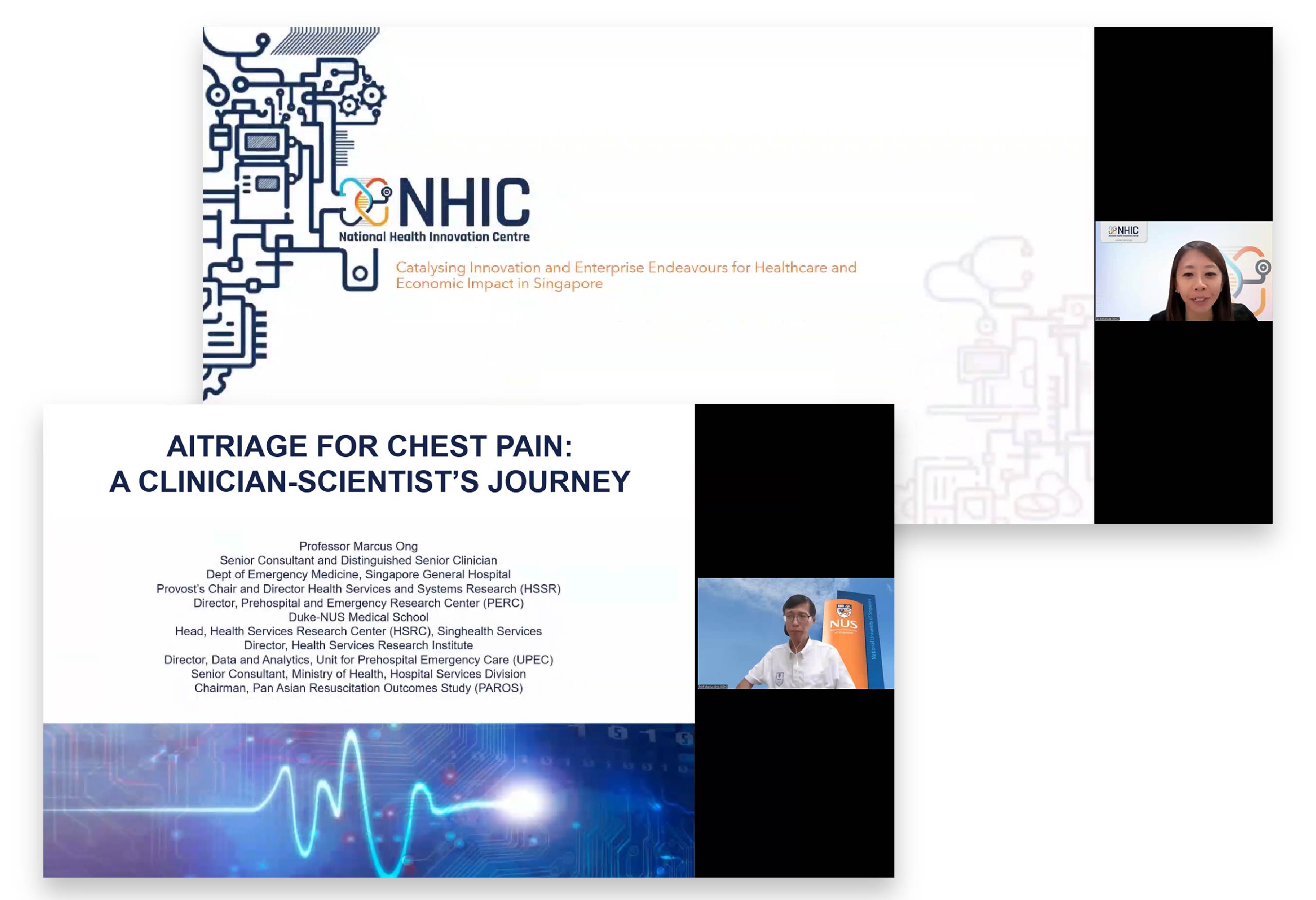
Dr Esther Lee, Assistant Director (Healthcare Innovation & Transformation) kicked off the webinar with a presentation on NHIC's role in identifying and commercialising promising clinical innovations across Singapore’s public healthcare institutions. She shared further about the I2Adopt grant, which is designed to evaluate the feasibility of implementing innovations, engage clinicians, healthcare clusters and policy divisions to address barriers, and provide strategies and resources to support adoption and scaling. She also spotlighted examples of innovations that have benefitted from the I2Adopt grant, including aiTriage™ and FxMammo, a radiological computer-assisted detection and software intended to aid in the detection of breast cancer on acquired mammography images.
Prof Marcus Ong, Senior Consultant & Distinguished Senior Clinician, Department of Emergency Medicine, Singapore General Hospital (SGH), highlighted a global challenge in healthcare: hundreds of millions of patients visit emergency departments, clinics or general practitioners each year for chest pain, yet up to 83% of these cases are not cardiac-related. Current triage methods often require serial blood tests to rule out low-risk cases, making the process expensive and resource-intensive for both hospitals and patients.
Heart rate variability (HRV), defined as the variation in time between consecutive heartbeats, has been studied extensively in critically ill ICU patients, as well as in conditions such as sepsis and trauma. Building on 20 years of research, the team led by Prof Marcus Ong developed aiTriage™, a solution designed to work within existing standards of care to identify low-risk patients for safe discharge and high-risk patients for earlier intervention. By integrating seamlessly into clinical workflows, aiTriage™ aims to support faster decision-making, more efficient use of hospital resources and ultimately, better patient outcomes.
Prof Ong outlined the journey of TIIM Healthcare, beginning with its formation as a research team in 2007. In 2015, the team received the Innovation to Develop (I2D) grant from the National Health Innovation Centre Singapore (NHIC). Later in 2023, it was awarded the Innovation to Adopt (I2Adopt) grant to evaluate aiTriage in a cross-cluster clinical implementation study involving institutions such as SGH and Tan Tock Seng Hospital. The study demonstrated that the safety of adopting aiTriage™ as a clinical decision support tool; it was effective in improving turnaround time for patients, and helpful in reducing unnecessary admissions.
Looking ahead, the team aims to extend aiTriage™ as a reliable and effective risk-stratification platform for conditions such as chest pain, heart failure, sepsis and trauma. Their long-term vision is to improve healthcare efficiency and enhance patient outcomes through timely care and intervention.
Speaking from his experience as a clinician scientist, Prof Ong stressed that medical innovation must be grounded in Science but also requires close collaboration with trusted business partners. He expressed gratitude to NHIC for their strong support in the team's innovation journey, highlighting that innovation goes beyond commercialisation, it is also about learning, creating value and ensuring effective implementation.
On a whole, the webinar highlighted the importance of bridging scientific research with clinical application to address pressing healthcare challenges. Through collaborative partnerships, sustained research and strong institutional support to enable adoption at scale, innovations such as aiTriage™ demonstrate how healthtech can enhance patient care, optimise resources and build a more resilient healthcare system for the future.